Qu'est-ce que la monnaie, au juste ?
Commodity? Fiat? Credit? The question sounds simple until you try to answer it.
Money in the macro workhorse
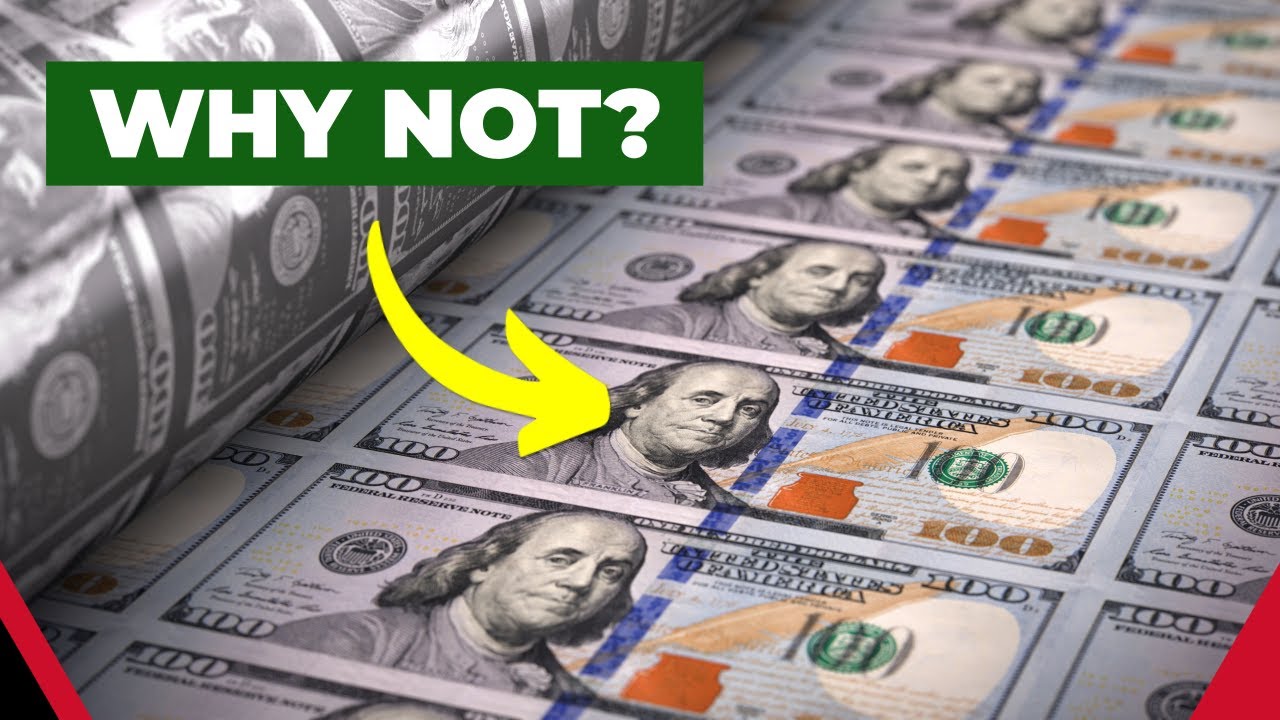
"Why can't we just print money to pay off debt?" The question sounds naive until you realize the answer depends entirely on what money actually IS.
The video's claim sounds radical, but notice what it assumes: that "money" is a thing the government creates. That assumption — innocent-sounding — is one of the most contested propositions in economics. Before you can evaluate whether the government can "run out" of money, you need to see what money does in the models economists actually use. And the answer is surprising: the workhorse model of intermediate macro doesn't even try to explain what money is.
Money supply and the LM curve. In IS-LM — the model that shaped generations of central bankers — money appears as a quantity: a stock $M$ that the central bank controls, and a demand $L$ that depends on income and the interest rate. People hold money for two reasons: they need it for transactions (which rises with income) and as a safe asset when bonds look risky (which falls as interest rates rise). The LM curve traces all combinations of income $Y$ and interest rate $i$ where the money market clears:
When the central bank increases $M$, there's excess supply of money at the old interest rate. People try to offload their excess cash by buying bonds, which pushes bond prices up and interest rates down. Lower rates stimulate investment, raising output. The transmission mechanism: $M \uparrow \;\Rightarrow\; i \downarrow \;\Rightarrow\; I \uparrow \;\Rightarrow\; Y \uparrow$.
When the central bank floods the economy with more cash, people try to get rid of the excess by buying bonds. That pushes interest rates down. Lower rates make borrowing cheaper, so businesses invest more, and the economy grows. The model traces this chain reaction in precise detail.
The remarkable avoidance. Notice what's happening. Money is treated as a thing the central bank controls — an exogenous variable. The model doesn't ask why people accept green pieces of paper (or electronic ledger entries) as payment. It doesn't explain how the convention of using dollars got started, or what would happen if people lost faith in it. Money just is, and the interesting question is what happens when you change the amount of it.
The IS-MP update. Modern central banks don't actually target the money supply. They target the interest rate. The Federal Reserve announces a target for the federal funds rate and adjusts reserves to hit it. This makes the LM curve horizontal at the target rate — the IS-MP framework (Romer 2000). The money supply becomes endogenous: whatever quantity of reserves the banking system needs to sustain the target rate, the central bank provides. This shift — from targeting $M$ to targeting $i$ — revealed that "money" as a policy variable was always more complicated than the textbook diagram suggested.
Why the nature question keeps returning. If money's nature doesn't matter for IS-LM, why does anyone care? Because reality keeps breaking the model's assumptions. In 2009, the Fed tripled the monetary base through quantitative easing — and inflation barely moved. If money is just $M$ in a supply-and-demand diagram, tripling it should have tripled prices. It didn't, because the relationship between "base money" and "the thing people spend" is far more complicated than IS-LM assumes. Then came Bitcoin, forcing the question from the other direction: can a decentralized algorithm create money without a central bank? IS-LM has nothing to say, because it never asked what money is in the first place.
"Money is not metal. It is not cloth. It is not a thing at all. It is a set of ideas about trust, about promises, and about the future."
— Felix Martin, Money: The Unauthorised Biography, 2013
"Can the government just print money?"
MMT says a currency-issuing government can never run out of money. The constraint is inflation, not solvency. But this claim depends entirely on what you think money is — and the workhorse macro model dodges that question entirely.
Does the nature of money matter for macroeconomics?
"Inflation is always and everywhere a monetary phenomenon in the sense that it is and can be produced only by a more rapid increase in the quantity of money than in output."
— Milton Friedman, The Counter-Revolution in Monetary Theory, 1970
Friedman's quantity theory is the IS-LM view pushed to its logical conclusion: money is a stock, inflation is what happens when you grow that stock faster than real output. This dominated central banking for decades. But when the Fed tripled the monetary base after 2008 and inflation stayed at 2%, Friedman's framework couldn't explain it. The relationship between "base money" and "the money people actually spend" turned out to be unstable — exactly because the model never asked what money is.
"The federal government can always afford to spend more. The question is never 'how will we pay for it?' The question is 'will it cause inflation?'"
— Stephanie Kelton, The Deficit Myth, 2020
Kelton's MMT turns Friedman upside down. Money isn't a stock the central bank controls — it's a creature of the state, created by government spending and destroyed by taxation. If you accept this ontology, the IS-LM model has the causation backward: the government doesn't "borrow" money that already exists; it creates money by spending and drains it through taxes. The deficit is the residual, not a constraint. The 2021–2022 inflation episode tested this view: massive deficit spending produced the fastest recovery in history — followed by the worst inflation in 40 years.
Where this leaves us
IS-LM gives you the macroeconomics of money — how changes in supply or demand affect output and interest rates. It's adequate for normal monetary policy questions. But it gives you no insight into what money fundamentally is, why some things become money and others don't, or what the limits of monetary systems are. The viral video's claim — "the government can't run out of money" — is a statement about money's nature, and the workhorse model has nothing to say about nature.
The standard model uses money without explaining it. For many purposes, that's fine. But to understand Bitcoin, inflation, or the collapse of currencies, you need to confront the question directly. Stage 2 presents three formal theories of why money has value — each with radically different implications for how the economy works.
The functions debate
"Bitcoin is the biggest bubble I have ever seen. It has no intrinsic value. Gold has been money for 5,000 years. Bitcoin has been around for 13 years and it is going to zero."
— Peter Schiff, financial commentator and gold advocate
Is Schiff right? To answer, you need to understand the three theories of what makes something "money."
Schiff's argument rests on a specific theory of money: that value comes from physical properties. Gold is money because it's scarce, durable, divisible, and intrinsically desirable. By this logic, Bitcoin — which is just code — can never be "real" money. But this is only one of three competing frameworks, and arguably the weakest one. The answer to "Is Bitcoin money?" depends entirely on which theory of money you hold.
Cash-in-advance (CIA). The simplest formal approach: you must have cash in hand before you can buy goods. Money is a transaction technology — a physical constraint on exchange.
where $P_t$ is the price level, $c_t$ is consumption, and $M_t$ is cash holdings. You can only consume what your cash allows. Holding money is costly because it earns no interest while bonds do. Inflation makes this cost higher. The Friedman rule follows: the optimal monetary policy sets the nominal interest rate to zero, which means deflating at the real interest rate:
$$i = 0 \quad \Rightarrow \quad \pi = -r$$Deflation makes holding money costless, eliminating the distortion.
CIA says money is a physical prerequisite for buying things. You need cash to shop. Holding cash costs you the interest you could have earned on bonds. Inflation makes this tax worse. The optimal policy would actually be mild deflation — making cash free to hold. Under this theory, anything that functions as a reliable transaction medium counts as money. Bitcoin? Only if you can actually buy groceries with it.
Money-in-utility (MIU). A more flexible approach: put real money balances directly into the utility function. People derive satisfaction from both consumption and the "convenience" of holding money:
This is a reduced-form shortcut. It doesn't explain why money is useful — it just assumes people value holding it. The Friedman rule still holds. MIU is tractable and widely used in graduate macro, but philosophically unsatisfying: it answers "why do people hold money?" with "because they like holding money."
MIU says people simply value having money on hand — the peace of mind, the optionality, the convenience. It doesn't explain why. Under this theory, Bitcoin could be money if people derive enough utility from holding it. And clearly some do — passionately. But "because people like it" isn't really an explanation. It's a description.
The Fiscal Theory of the Price Level (FTPL). A radically different approach. FTPL says money's value depends on the government's fiscal backing:
where $B$ is nominal government debt and the denominator is the present value of future surpluses (tax revenue minus non-interest spending). If the government credibly promises surpluses, money retains value. If it doesn't, the price level must rise to reduce the real value of outstanding debt. Inflation is not "too much money chasing too few goods." It's the market repricing government liabilities when fiscal promises become less credible.
FTPL says money is like stock in a company. A company's share price depends on expected future profits. Government money's value depends on expected future tax surpluses. If the government promises more spending than future taxes can cover, the "stock price" of its currency falls — meaning prices rise. This is how markets call the government's bluff. Under this theory, Bitcoin has no fiscal backing at all — no government, no surpluses, no tax base. It should be worth zero.
What this means for Schiff's claim. Under CIA, money is whatever you need to transact. Gold works. Dollars work. Bitcoin works — if merchants accept it. Under MIU, money is whatever people value holding. Gold works. Bitcoin works. Seashells worked for centuries. Under FTPL, money must be backed by a fiscal authority. Only government currencies qualify. Bitcoin is fundamentally disqualified.
Schiff's gold standard argument is actually the weakest of the three. CIA doesn't privilege gold — any accepted medium works. MIU doesn't privilege gold — people clearly value holding Bitcoin. And FTPL disqualifies gold just as firmly as it disqualifies Bitcoin: neither has a government running surpluses behind it. Schiff is making a commodity theory argument that none of the mainstream models endorse.
The heterodox challengers. Two alternative traditions reject the framework above entirely. Credit theory (Graeber, Mehrling) says money is not a commodity that evolved from barter — the textbook origin story is historically false. Anthropological evidence shows credit systems preceded coinage. All money is someone's IOU. Bank deposits are bank IOUs. Central bank money is a government IOU. If money is credit, the supply is endogenous — banks create money by lending — and all three mainstream models get the causation backward.
Chartalism / MMT says money is a creature of the state. Taxes create demand for government currency — you need dollars to pay your tax bill, which gives dollars value. The government spends first (creating money) and taxes later (draining money to control inflation). This reverses the textbook causation entirely. Under this theory, Bitcoin cannot be money in any meaningful macroeconomic sense: no state demands it in tax payments, so nothing anchors its value except collective belief.
"Bitcoin is the biggest bubble I have ever seen. It has no intrinsic value."
— Peter Schiff
"Is Bitcoin real money?"
Peter Schiff says Bitcoin has no intrinsic value and is going to zero. Satoshi Nakamoto designed it to replace the entire monetary system. The answer depends on which theory of money you believe — and each theory gives a different verdict.
What gives money its value?
"I've been working on a new electronic cash system that's fully peer-to-peer, with no trusted third party."
— Satoshi Nakamoto, Cryptography Mailing List, October 31, 2008
Nakamoto's design solved a technical problem — digital scarcity without a central authority — but it implicitly endorsed a commodity theory of money. Bitcoin is designed to mimic gold: fixed supply, costly to "mine," no one's liability. But the commodity theory is exactly what mainstream economics moved away from. The dominant models (CIA, MIU, FTPL) all assume money's value comes from its function or backing, not its physical properties. Nakamoto built the most sophisticated monetary technology in history on the least sophisticated monetary theory.
"Inflation is always and everywhere a fiscal phenomenon. When the government issues debt it cannot repay from future surpluses, the price level must rise to reduce the real value of that debt."
— John Cochrane, The Fiscal Theory of the Price Level, 2023
Cochrane's FTPL provides the strongest theoretical case against Bitcoin as money: without a fiscal authority running surpluses, there is no fundamental anchor for value. Government money has a floor — the present value of future surpluses. Bitcoin's floor is zero. But this cuts both ways. If the government's fiscal promises become incredible — if surpluses never materialize — government money's floor also drops toward zero. That's what hyperinflation is. And in a world of ballooning sovereign debt, the question of whose floor is more credible may not have the obvious answer FTPL proponents assume.
Where this leaves us
Money is a self-reinforcing equilibrium of mutual acceptance. CIA captures the transaction role. MIU captures the convenience role. FTPL captures the fiscal backing. Credit theory captures the banking mechanism. Chartalism captures the state's role. No single theory is complete — each illuminates one facet while leaving others in shadow. The correct answer to "what is money?" is: it depends on which property of money you're asking about. That's not a dodge — it's a reflection of the fact that money is genuinely multi-dimensional.
All of the theories above assume a single money in a single economy. But there are hundreds of national currencies, and some are far more powerful than others. The dollar isn't just American money — it's the world's money. Stage 3 takes the question international: why is the dollar dominant, and could anything replace it?
Digital money and the future
"The dollar is our currency, but it's your problem."
— John Connally, US Treasury Secretary, to European finance ministers, 1971
The US Treasury Secretary said this to European finance ministers in 1971. He was right — and the consequences are still playing out.
Connally was speaking just months after Nixon ended the dollar's convertibility to gold, blowing up the Bretton Woods system that had governed international finance since 1944. European ministers expected the end of dollar dominance. Instead, the dollar became more dominant without the gold anchor. Fifty years later, Connally's quip remains the most concise description of the international monetary system: the US gets to print the world's money, and everyone else lives with the consequences.
Purchasing Power Parity (PPP). The simplest theory of exchange rates: in the long run, a dollar should buy the same basket of goods everywhere. If a Big Mac costs \$5 in New York and ¥500 in Tokyo, the exchange rate should be 100 ¥/\$. In practice, PPP holds only roughly and only over decades. The persistent deviations tell us something important: exchange rates aren't just about goods prices. They reflect the relative attractiveness of holding different moneys as assets.
Uncovered Interest Parity (UIP). A second building block: the expected return on holding different currencies should equalize. If US bonds yield 5% and Japanese bonds yield 1%, UIP says the dollar should be expected to depreciate by 4% against the yen. In reality, UIP fails spectacularly. The "carry trade" — borrowing in low-rate currencies and investing in high-rate ones — has been profitable for decades. The dollar earns a persistent excess return that UIP says shouldn't exist. Why? Because the dollar isn't just a currency. It's the global safe asset.
The UIP condition: $E_t[e_{t+1}] - e_t = i_t - i_t^*$, where $e$ is the log exchange rate and $i, i^*$ are domestic and foreign interest rates. If UIP held, carry trades would earn zero excess return. Empirically, they earn positive returns — the "forward premium puzzle." The dollar's safe-asset premium explains a large share of this anomaly: in crises, global investors flee to dollars regardless of interest rate differentials.
Theory says currencies with higher interest rates should depreciate to equalize returns. In practice, they don't. Investors who borrow in yen (low rates) and invest in dollars (high rates) keep making money. The reason is that the dollar has a "safety premium" — when crises hit, the whole world wants dollars, driving the price up even further. The dollar isn't just money. It's insurance.
The dollar's exorbitant privilege. The dollar's special position creates what economists call an "exorbitant privilege": the US can borrow at lower rates than its fundamentals justify, run persistent trade deficits financed by foreign central banks' demand for dollar reserves, and extract seigniorage not just from American cash holders but from the entire global financial system. Foreign central banks hold trillions in US Treasury bonds — not because they're the best investment, but because they need dollar reserves for trade settlement, crisis intervention, and exchange rate management. This is self-reinforcing: the dollar is the reserve currency because everyone uses it, and everyone uses it because it's the reserve currency.
How the system was built. This wasn't a natural market outcome. The 1944 Bretton Woods agreement pegged other currencies to the dollar and the dollar to gold. When Nixon ended gold convertibility in 1971 — the moment Connally was celebrating — the system was supposed to become symmetric. Instead, the dollar retained its central role through institutional inertia, network effects, and the depth of US financial markets. The petrodollar system (oil priced in dollars) reinforced it. US military power and dollar-based sanctions cemented it. Money, at the international level, is inseparable from geopolitics.
Challengers to dollar dominance. Three forces push against the current system. First, de-dollarization: China, Russia, and the BRICS nations are building alternative payment systems and settling some trade in yuan. Second, central bank digital currencies (CBDCs): a digital yuan with instant cross-border settlement could bypass the dollar-based SWIFT system entirely. Third, cryptocurrency: Bitcoin and stablecoins propose money without a state — decentralized, borderless, censorship-resistant. The question is whether any of these can overcome the network effects that sustain dollar dominance.
"The dollar's exorbitant privilege is coming to an end. BRICS nations, digital currencies, and the weaponization of the dollar through sanctions are eroding the foundation of dollar hegemony."
— Zoltan Pozsar, Credit Suisse Global Money Notes, 2022
Is the dollar's reign ending?
De-dollarization is the most discussed topic in international finance. Russia was cut off from the dollar system via sanctions. China is settling more trade in yuan. BRICS nations are exploring alternatives. But the dollar's share of global reserves has declined only from 71% to 58% over two decades. Network effects are powerful — and there's no credible alternative yet.
Does money need a state?
"Inflation is always and everywhere a monetary phenomenon in the sense that it is and can be produced only by a more rapid increase in the quantity of money than in output."
— Milton Friedman, The Counter-Revolution in Monetary Theory, 1970
Friedman's monetarism underpinned the dollar system for decades: the Fed controls the money supply, and stable money means a stable anchor for the world. But if the Fed is the world's central bank — as Connally's quip implies — then Friedman's framework applies globally. US monetary policy isn't just about the US economy. It's about the global financial system. When the Fed raises rates, emerging markets face capital flight. When it prints, commodities spike worldwide. Connally's "your problem" is Friedman's quantity theory applied to the planet.
"I've been working on a new electronic cash system that's fully peer-to-peer, with no trusted third party."
— Satoshi Nakamoto, Cryptography Mailing List, October 31, 2008
Nakamoto's project is the most radical challenge to Connally's world. If money can exist without a state, then the dollar's privilege rests on nothing more durable than network effects and habit. But the post-Bretton Woods era was also supposed to end dollar dominance, and it didn't. The 2008 financial crisis — which originated in the US — paradoxically strengthened the dollar as the world fled to dollar-denominated safe assets. Stablecoins, which are the crypto economy's actual medium of exchange, are overwhelmingly denominated in dollars — extending dollar dominance into digital infrastructure rather than challenging it.
"Bitcoin is the biggest bubble I have ever seen. It has no intrinsic value. Gold has been money for 5,000 years."
— Peter Schiff
Schiff's gold-standard nostalgia is the mirror image of Nakamoto's decentralized utopianism. Both reject the current system — Schiff because it lacks commodity backing, Nakamoto because it requires trusting institutions. But the Connally world persists because neither gold nor Bitcoin can provide what the dollar provides: deep, liquid financial markets, a credible fiscal authority, and the institutional infrastructure to settle trillions in daily transactions. Reserve currency status is a tipping-point phenomenon, not a spectrum — and no challenger is remotely close to the tipping point.
The verdict
Money at the international level is deeply political. The theoretical question "what is money?" has a practical answer in global finance: money is whatever the dominant power establishes as the medium of international exchange, sustained by network effects, institutional inertia, military power, and the absence of a credible alternative. The dollar's dominance is real and durable — but not permanent. History shows reserve currencies do change (the pound sterling yielded to the dollar over roughly 1914–1945), but transitions take decades and require both a declining incumbent and a rising challenger with deep, liquid, open financial markets. China has the economic scale but not the financial openness. The euro has the institutional quality but not the fiscal unity. Bitcoin has the technology but not the stability. For now, the answer to "what is the world's money?" remains: the dollar, for lack of a better option.
Where this leaves us
We started with a viral video claiming the government can't run out of money, a gold bug insisting Bitcoin is worthless, and a Treasury Secretary telling Europe that the dollar is their problem. Three provocations, three stages, one answer: "What is money?" depends on what you need money to do.
- The macro workhorse (Stage 1): Money is a quantity ($M$) that the central bank manages to influence interest rates and output. This is operationally useful but philosophically empty. When the Fed tripled the monetary base and nothing happened to inflation, the limits of treating money as a simple stock became impossible to ignore.
- The theories of money (Stage 2): Money has value because you need it to transact (CIA), because holding it is convenient (MIU), because the government backs it with future surpluses (FTPL), because it's a credit instrument embedded in banking (credit theory), or because the state demands it in tax payments (chartalism). Each captures something real. None captures everything. Peter Schiff's commodity theory is the one option that none of the mainstream models endorse — yet it's the most popular view on the internet.
- The international system (Stage 3): Money is power. Connally was right: the dollar is America's currency and the world's problem. This dominance was constructed at Bretton Woods, survived the end of gold convertibility, and strengthened through every subsequent crisis. Challengers exist — yuan, euro, CBDCs, Bitcoin — but none has overcome the incumbent's network advantages.
The next time someone tells you money is "just a medium of exchange" or "just a government IOU" or "just a social convention," you'll know they're each capturing one dimension of a genuinely multi-dimensional phenomenon. Money is a transaction technology, a convenience good, a government liability, a credit instrument, a social convention, and a geopolitical weapon — all at once. The emergence of digital currencies is forcing the question open again, because for the first time in centuries, the technology of money is changing faster than the institutions that govern it.