Why are some countries rich and others poor?
Capital? Ideas? Institutions? Geography? Culture? The biggest question in economics has no consensus.
What the numbers actually show

50 million views. 200 years of global income in 4 minutes. But what CAUSED the pattern?
Hans Rosling's animated chart is mesmerizing: countries cluster in the poor-and-sick corner for most of human history, then some rocket toward rich-and-healthy while others barely move. To understand that divergence, you need one metric and its limits.
GDP per capita at purchasing power parity. Economists measure living standards using GDP per capita — total market value of goods and services produced, divided by population. But comparing across countries in raw dollar terms is misleading: a haircut that costs \$30 in New York costs \$2 in Dhaka. Purchasing power parity (PPP) adjusts for these price differences, giving a more honest comparison of actual material living standards.
At PPP, the numbers are staggering. The United States sits at roughly \$80,000 per person. India is around \$9,000. The Democratic Republic of the Congo is about \$600. The richest countries produce more than 100 times the output per person of the poorest. This isn’t a rounding error — it’s the defining fact of the global economy.
What GDP misses. GDP per capita is a starting point, not the finish line. It misses the informal economy — unregistered businesses, street vendors, subsistence farmers, and household production that constitute 30–60% of economic activity in many developing countries. It misses inequality — a country’s GDP can rise while most of its citizens get poorer. It misses environmental degradation: a country that liquidates its forests registers growth even as it destroys its productive base. And it misses unpaid care work that sustains the entire economy without appearing in any national account.
Alternative metrics. The Human Development Index (HDI) combines income with life expectancy and education. Sri Lanka has a GDP per capita below that of oil-rich Equatorial Guinea, but vastly superior health and education outcomes. The metric you choose shapes the question you ask.
"GDP measures everything except that which makes life worthwhile."
— Robert F. Kennedy, University of Kansas speech, 1968
Does GDP measure what matters?
The Easterlin paradox suggests that above a threshold, more GDP doesn't make people happier. Bhutan famously tracks Gross National Happiness instead. But countries with higher GDP per capita also have lower infant mortality, longer life expectancy, and more political freedom. Is GDP a bad measure, or just an incomplete one?
Can we even measure the gap?
"We can see how the world went from being divided to converging. Today, everyone — including the poorest — lives longer. The seemingly impossible has already happened."
— Hans Rosling, Factfulness, 2018
Rosling's optimism has a basis in fact. Since 1990, more than a billion people have been lifted out of extreme poverty. Life expectancy in Sub-Saharan Africa rose from 50 to 62 years between 2000 and 2020. But Rosling's animation hides a crucial detail: most of the convergence is driven by two countries, China and India, which together account for a third of the world's population. Exclude them and the picture is far less encouraging. Many Sub-Saharan African countries have lower real income per capita today than they did in 1980.
"GDP tells us about market transactions, not about well-being. We should be asking not 'how much does a country produce?' but 'what are its citizens able to do and be?'"
— Amartya Sen, Development as Freedom, 1999
Sen's capabilities approach insists that income is a means, not an end. A country with high GDP but no healthcare, no political freedom, and no security for women is not "developed" in any meaningful sense. Cuba has a lower GDP per capita than much of Latin America but higher life expectancy than the United States. Kerala, one of India's poorer states, has literacy and health outcomes that rival wealthy nations. But Sen's critique doesn't dissolve the puzzle — even on multidimensional measures, the gap between rich and poor countries is enormous and persistent. Material prosperity, however imperfectly measured, is strongly correlated with almost every other good outcome.
Where this leaves us
GDP per capita is an imperfect but indispensable starting point. The gap between rich and poor countries is real, enormous, and persistent — even after adjusting for PPP, informal activity, and alternative welfare measures. Rosling's animation shows that the gap has been closing in some dimensions, but the core puzzle remains: why did some countries rocket ahead while others stayed behind? Measurement tells us the gap exists. It doesn’t tell us why.
The first formal explanation comes from the Solow growth model — the workhorse of growth economics for half a century. Its answer: countries are poor because they haven’t accumulated enough capital. Simple, elegant, and ultimately insufficient.
Capital deepening
"The consequences for human welfare involved in questions like these are simply staggering: Once one starts to think about them, it is hard to think about anything else."
— Robert Lucas, "On the Mechanics of Economic Development," 1988
This line launched modern growth theory. Lucas was describing what happens when you realize the income gap between nations is a factor of 50 — and existing theory can't explain it.
The most influential growth model in economics was built by Robert Solow in 1956. Its logic is intuitive: countries that save more accumulate more capital (machines, factories, infrastructure), and more capital means more output per worker. Poor countries are poor because they haven’t saved enough.
The production function. Output per worker depends on capital per worker and technology:
where $y$ is output per worker, $k$ is capital per worker, $A$ is total factor productivity (TFP), and $\alpha$ is capital’s share of income (typically around 1/3). The key feature: diminishing returns to capital. The first factory in a country adds enormous output; the thousandth adds less.
Steady-state income. In the long run, the economy converges to a steady state where investment exactly replaces depreciated capital:
where $s$ is the saving rate, $n$ is the population growth rate, and $\delta$ is the depreciation rate. Higher saving leads to higher steady-state income. Lower population growth leads to higher steady-state income.
Think of each country as filling a bathtub. Saving is the faucet (new capital flowing in), depreciation and population growth are the drain (old capital wearing out, more workers sharing the same machines). The water level — capital per worker — settles where inflow equals outflow. Countries with bigger faucets (higher saving) or smaller drains (lower population growth) end up with more capital per worker, and therefore higher income.
The calibration problem. Here is where the Solow model breaks down. When you plug in realistic values for $s$, $n$, and $\delta$, the model predicts income differences of a factor of 2 to 3 between rich and poor countries. The actual gap is a factor of 50. The model can’t explain the data without attributing most of the gap to differences in $A$ — total factor productivity — which is exogenous in the model. Solow doesn’t explain $A$; he takes it as given. The model “explains” the income gap by pointing to a variable it doesn’t explain. It’s a confession of ignorance dressed in algebra.
Mankiw, Romer, and Weil (1992) tried to rescue Solow by adding human capital — education and skills. With human capital included, the augmented model explains more of the cross-country variation. But the fundamental problem remains: what determines $A$? Why is productivity so much higher in some countries than others?
"For God's sake, please stop the aid!"
— Dambisa Moyo, The Wall Street Journal, 2009
Can foreign aid close the gap?
If the Solow model is right and poor countries lack capital, the solution seems obvious: transfer capital from rich countries. That's the logic of foreign aid. Trillions of dollars have been spent on this premise. Dambisa Moyo argues it made things worse.
Is capital the answer?
"A poverty trap means that the poor are too poor to save enough to grow. External aid can provide the 'big push' needed to escape. The amounts required are small relative to rich-world income — about 0.7% of GNP."
— Jeffrey Sachs, The End of Poverty, 2005
Sachs' argument has clean Solow logic: if diminishing returns make capital more productive where it's scarce, then transferring capital from rich to poor countries should generate explosive returns. The problem is empirical: decades of aid have produced disappointing growth results. Sachs responds that aid has been too small, too fragmented, and poorly targeted. The Millennium Villages showed promising results in some dimensions but failed to demonstrate the self-sustaining growth that the big-push theory predicts.
"The West spent \$2.3 trillion on foreign aid over the last five decades and still had not managed to get twelve-cent medicines to children to prevent half of all malaria deaths. The big push didn't work before and it won't work now."
— William Easterly, The White Man's Burden, 2006
Easterly's critique goes beyond "aid is wasted" to a deeper point about knowledge and incentives. Top-down planners — whether at the World Bank or in government — don't have the local knowledge needed to allocate resources well. Only "searchers" — entrepreneurs, local organizations, communities — can discover what works in each context. Aid bypasses this discovery process. The critique has limits: some top-down interventions (eradication of smallpox, PEPFAR for HIV/AIDS) have been spectacularly successful. But Easterly is right that sustained growth has never come from external transfers.
Where this leaves us
The Solow model is essential scaffolding. It teaches you that capital accumulation alone cannot explain the gap — which is itself a crucial insight. Most of the variation across countries lives in $A$, total factor productivity, the variable Solow doesn't explain. The foreign aid debate is the practical consequence: if the binding constraint were just capital, aid would work. It doesn't — or at least, not at the macro level. Something else determines whether capital gets used productively.
If capital can’t explain the gap, what can? The next generation of growth economists had a radical answer: ideas. Ideas don’t depreciate, they can be shared without being used up, and they compound. But if ideas are the engine of growth, why don’t poor countries simply copy the ideas that rich countries already have?
The ideas answer
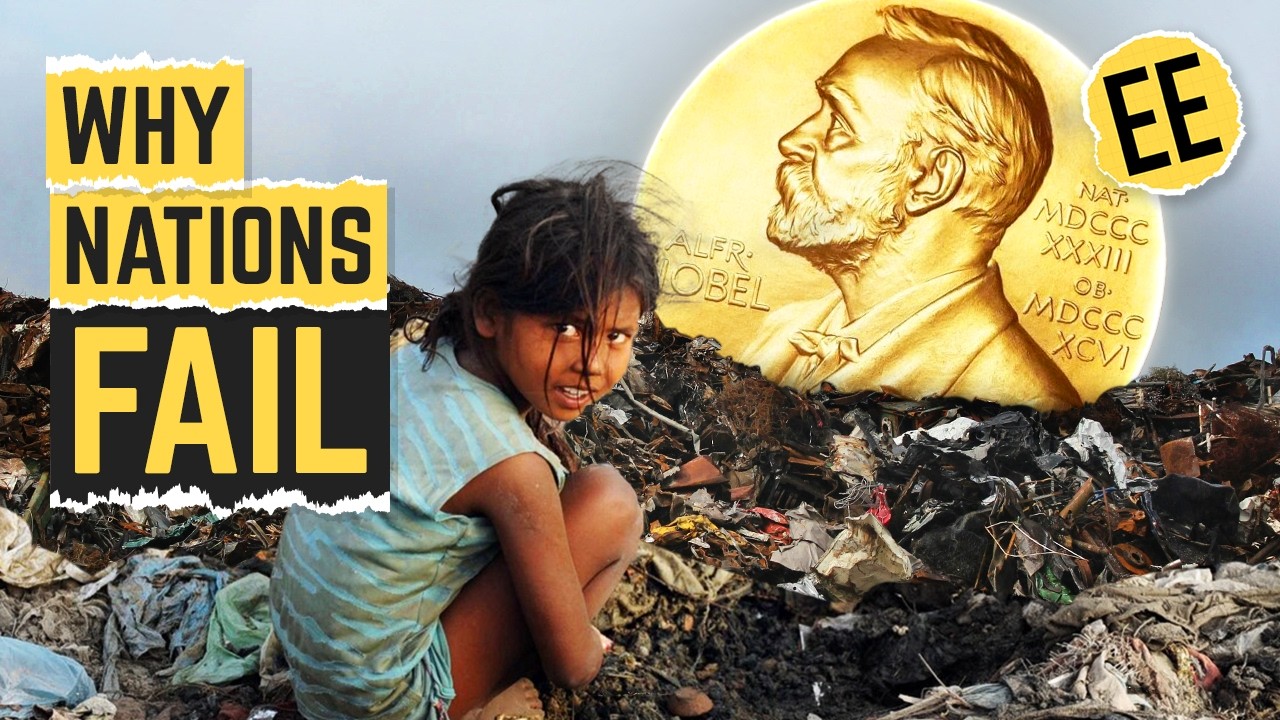
The 2024 Nobel Prize in Economics went to the "institutions" answer. But before institutions, economists tried "ideas" — and Acemoglu's own work built on where that theory fell short.
In 1990, Paul Romer published the paper that launched endogenous growth theory. His insight was deceptively simple: ideas are fundamentally different from physical goods. A machine can only be used by one factory at a time. An idea — the design for a semiconductor, the formula for a vaccine, the algorithm behind a search engine — can be used by everyone simultaneously without being depleted. This non-rivalry changes the mathematics of growth completely.
Non-rivalry and increasing returns. Physical capital is rival: if one factory uses a lathe, another factory can’t. Ideas are non-rival: once someone invents the transistor, every chip manufacturer on Earth can use the design simultaneously. Double the number of workers using an idea, and you roughly double the output — without needing to double the idea.
The Romer model. A fraction of the labor force works in R&D, producing new ideas. New ideas improve productivity, which generates profits that finance further R&D:
where $g$ is the growth rate of ideas (and therefore of income), $\delta_A$ is the productivity of the R&D sector, and $L_A$ is the number of researchers. More researchers means more ideas means faster growth — and the effect is permanent, not temporary.
The Solow model says you get richer by saving more. Romer says you get richer by thinking more. Countries that invest in R&D and reward innovation grow faster — permanently. This is why Silicon Valley matters more for American prosperity than the steel mills of Pittsburgh.
Growth accounting. When economists decompose cross-country income differences into contributions from capital, labor, and TFP, the results are sobering. TFP — closely related to technology and ideas — accounts for 50–70% of income differences. Capital and labor together explain only 30–50%. The ideas story is quantitatively dominant.
But if ideas are non-rival, why don't poor countries just copy them? The smartphone was invented once; it can be manufactured anywhere. The fact that technology doesn’t diffuse freely suggests the barrier isn’t the idea itself but something about the environment — institutions, infrastructure, governance — in which the idea would need to operate. This is the question that pushed the field toward the institutions answer.
"It doesn't matter whether the cat is black or white, as long as it catches mice."
— Deng Xiaoping, 1961 — the pragmatism that launched China's market reforms
"Is the China model replicable?"
China lifted 800 million people out of poverty in 40 years — the greatest economic transformation in human history. It did so under one-party rule. Does this prove authoritarian governance can deliver growth?
Are ideas enough?
"A nonrival, partially excludable good is not just a nuance. Put that feature into a growth model and you get a completely different theory: growth driven by ideas, sustained by incentives, and with no natural tendency to stop."
— Paul Romer, "Endogenous Technological Change," Journal of Political Economy, 1990
This is the paper that earned Romer the 2018 Nobel Prize. His insight was that ideas require upfront costs to produce but zero marginal cost to use. This creates increasing returns, which breaks the Solow framework. In Romer's world, growth is driven by the deliberate allocation of resources to research — making it endogenous to policy choices. Countries that invest in ideas grow faster, permanently. The implication: the income gap reflects not just different capital stocks but different idea-production systems.
"If ideas are the engine of growth, and ideas are non-rival, why hasn't the developing world simply adopted the technologies that already exist? The barrier is not knowledge. It is the institutions that determine whether knowledge gets used."
— Daron Acemoglu, "Directed Technical Change," Review of Economic Studies, 2002
Acemoglu's critique of pure ideas-driven growth pointed the field toward its next stage. If ideas are freely available, the binding constraint must be something else — the institutional environment that determines whether ideas get adopted, adapted, and deployed. This is why the Nobel went to institutions rather than ideas alone: ideas explain the proximate mechanism of growth, but institutions explain why some countries run the engine and others don't.
Where this leaves us
Ideas are the proximate engine of growth — this is Romer’s lasting contribution. TFP accounts for the majority of cross-country income differences. But ideas are endogenous to institutions, incentives, and social structures. If technology were the only barrier, poor countries could copy their way to prosperity. They can't, and understanding why requires looking at the rules of the game, not just the pieces on the board.
If technology is available but not adopted, the bottleneck must be something else. The next stage presents the most influential answer of the past two decades: institutions. The rules of the game that determine who invests, who innovates, and who captures the returns.
The institutions answer
Acemoglu, Johnson, and Robinson won the 2024 Nobel for showing that colonial-era institutions — set up centuries ago — still determine which countries are rich today. The evidence is written in settler mortality records.
In 2001, Acemoglu, Johnson, and Robinson (AJR) published the paper that reshaped development economics. Their argument: the wealth of nations is determined not by geography, culture, or natural resources, but by institutions — the rules of the game that govern economic and political life.
The AJR instrumental variable strategy. The core challenge is endogeneity: rich countries have good institutions, but good institutions may also be a consequence of being rich. AJR solved this with an ingenious instrument: settler mortality. Where European colonizers faced low mortality, they settled in large numbers and built inclusive institutions — property rights, courts, representative government. Where mortality was high, they didn’t settle; instead, they built extractive institutions designed to strip resources with minimal European presence. The mortality rates of 200 years ago predict institutional quality today, which in turn predicts income.
Where European colonizers faced low mortality (North America, Australia, New Zealand), they settled permanently and built institutions to protect their own property and rights — courts, parliaments, property registries. Where mortality was high (West Africa, Central America), they set up extraction operations — mines, plantations, forced labor. The inclusive institutions evolved into prosperous democracies. The extractive ones persisted and kept countries poor. The historical accident of disease environment centuries ago still shapes economic outcomes today.
Extractive vs. inclusive institutions. Inclusive institutions have three features: secure property rights, a level playing field, and checks on political power. Extractive institutions do the opposite: concentrate power, allow elites to expropriate wealth, and block economic opportunities for the majority. The key insight: extractive institutions are stable. The elite benefits from them and has the power to maintain them. This creates a poverty trap — not because poor countries lack resources or ideas, but because their institutional structure prevents those resources and ideas from being productively deployed.
The colonial reversal. The most striking evidence is the "reversal of fortune." Countries that were richest in 1500 (Mexico, Peru, India) are relatively poorer today. Countries that were sparsely populated and less developed in 1500 (the US, Canada, Australia, New Zealand) are the richest today. AJR argue this reversal is explained by institutions: densely populated, rich regions attracted extractive colonization, while "empty" regions attracted settlement and inclusive institutions.
"Europeans set up different types of institutions in different colonies. In some, they created institutions that were highly extractive. In others, they built institutions that protected property rights and encouraged investment."
— Acemoglu, Johnson & Robinson, AER, 2001
"Did colonialism cause poverty?"
The 2024 Nobel Prize says colonial institutions are the root cause of the global income gap. But was colonialism a single thing — or does the label cover a hundred different stories?
Institutions, geography, or culture?
"Nations fail because their extractive economic institutions do not create the incentives needed for people to save, invest, and innovate. Extractive political institutions support these economic institutions by cementing the power of those who benefit from the extraction."
— Daron Acemoglu & James Robinson, Why Nations Fail, 2012
The Acemoglu-Robinson framework is elegantly simple: inclusive institutions create a virtuous cycle (broad participation leads to investment leads to growth leads to more inclusive institutions), while extractive institutions create a vicious one (concentrated power leads to extraction leads to poverty leads to continued concentrated power). The Nobel committee endorsed this view. But elegance is not the same as completeness. China's explosive growth under what AR would classify as extractive institutions is the hardest case for the framework. AR's response — that extractive-institution growth is real but unsustainable — remains a prediction, not a demonstrated fact.
"You can't grow out of malaria. You can't grow out of being landlocked in a tropical climate with no access to navigable waterways. Geography is not destiny, but it constrains destiny far more than the institutionalists admit."
— Jeffrey Sachs, "Institutions Don't Rule," NBER Working Paper, 2003
Sachs' geography counter-thesis has real empirical support. Tropical countries are poorer than temperate ones even after controlling for institutions. Landlocked countries in Africa face transport costs 3–5 times higher than coastal ones. Malaria-endemic regions show persistently lower growth. But the correlation between geography and institutions is precisely the identification challenge — does malaria cause bad institutions, or do bad institutions cause failure to control malaria? Singapore is tropical and one of the richest places on Earth. The debate is not geography or institutions but how they interact.
Where this leaves us
Institutions almost certainly matter a great deal — the causal evidence from AJR, Dell, Nunn, and others is too strong and too varied to dismiss. But "institutions" is a broad category, and the extractive-vs-inclusive binary is a useful simplification, not a complete theory. Geography, culture, and historical contingency interact with institutions rather than being alternatives to them. The honest position: institutions are necessary for development, but the story of how they emerge, change, and interact with other forces is far more complex than any single framework captures. And this raises the hardest question: if institutions matter so much, how do you actually change them?
Grand theories are satisfying, but do they survive contact with data? The final stage confronts the macro question with micro evidence. Can randomized experiments — the same methodology used to test drugs — tell us how to make entire nations less poor?
Inclusive and extractive
"We wanted to show that it is possible to make progress against the biggest problems in the world."
— Esther Duflo, Nobel Prize Lecture, 2019
After 200 years of theory — capital, ideas, institutions — can we actually help? Duflo, Banerjee, and Kremer won the Nobel for trying to find out, one randomized experiment at a time.
The RCT revolution. A randomized controlled trial in development economics works like a clinical trial. You randomly assign villages, households, or individuals to a treatment group (which receives an intervention) and a control group (which doesn’t). The difference in outcomes is the causal effect, free of the selection bias that plagues observational studies.
The results have been illuminating. GiveDirectly’s unconditional cash transfers increase recipient income and well-being with minimal waste. Miguel and Kremer (2004) showed that deworming schoolchildren has enormous long-run returns — a \$0.50-per-child treatment that increases lifetime earnings by thousands of dollars. Information interventions change behavior: telling farmers about new seed varieties increases adoption; telling parents about the returns to education increases enrollment.
The power of an RCT is simple: randomly assign some villages to get a program and others to serve as a comparison group. Any difference in outcomes must be caused by the program, because the two groups were identical on average before the intervention. It's the gold standard for causal evidence. The limitation is also simple: the result tells you what happened in those villages, not necessarily what will happen elsewhere.
The aggregation problem. The interventions that RCTs evaluate are micro. The income gap between rich and poor countries is macro. A deworming program that raises individual earnings by 20% is transformative for those individuals but barely registers in national income statistics. The gap between the DRC and Denmark is not caused by a shortage of bed nets. This creates a fundamental tension: the interventions we can rigorously evaluate are too small to explain the development gap, and the forces large enough to explain the gap — institutions, industrial policy, macroeconomic management — can’t be randomized.
Structural estimation. One approach to bridging this gap builds economic models with explicit mechanisms, estimates their parameters using micro data, and then simulates counterfactuals at the macro level. Hsieh and Klenow (2009) showed that reallocating resources from less productive to more productive firms in India and China could increase manufacturing TFP by 40–60%. The misallocation story connects micro evidence (why specific firms are unproductive) to macro outcomes (why whole economies are poor).
Think of it this way: RCTs tell you that a specific medicine cures a specific disease. But the patient has fifty diseases at once, and some of them are caused by the hospital itself. You need both the targeted medicine and a theory of what's wrong with the hospital.
External validity. Even when an RCT produces a clean result, the question remains: does it generalize? A cash transfer program that works in rural Kenya may not work in urban Bangladesh. Angus Deaton argued that RCTs without theory are blind — they tell you that something worked, not why, and without the "why," you can’t predict whether it will work elsewhere.
"We wanted to show that it is possible to make progress against the biggest problems in the world."
— Esther Duflo, 2019
"Does foreign aid work?" (revisited)
Stage 2 asked whether capital transfers drive growth. Stage 5 has a sharper question: do targeted interventions — backed by RCT evidence — change the answer?
Experiments or grand theories?
"Randomized experiments have fundamentally changed development economics. We can now say with confidence which interventions improve the lives of the poor. The challenge is taking what we've learned to scale."
— Abhijit Banerjee & Esther Duflo, Poor Economics, 2011
Banerjee and Duflo's contribution was methodological as much as substantive. By insisting on experimental evidence, they raised the evidentiary bar for the entire field. Before RCTs, development policy was driven by ideology and anecdote. After, there was a credible evidence base for specific interventions. But "taking what we've learned to scale" is precisely where the micro-macro gap bites: an intervention that works in 50 villages may not work when scaled to 50 million people, because general equilibrium effects — price changes, labor market shifts, political responses — kick in.
"There is nothing as catastrophic for the study of development as the obsession with randomized controlled trials. We are studying bed nets when we should be studying why some countries industrialize and others don't."
— Lant Pritchett, paraphrased from multiple interviews and papers
Pritchett's critique resonates with many development practitioners. The countries that actually escaped poverty — South Korea, Taiwan, China, Botswana — did so through industrial policy, institutional reform, and macroeconomic management, none of which can be studied through randomized experiments. The RCT revolution may have inadvertently narrowed the field's attention to questions amenable to experimentation while the truly important questions — about institutions, power, and political economy — went under-studied. But Pritchett's alternative — studying industrialization through case studies and structural models — has its own evidentiary challenges.
The verdict
The honest answer to "why are some countries poor?" is layered: institutions and ideas are the fundamental causes, operating through property rights, human capital, technology adoption, and political stability. RCTs help us understand specific mechanisms within those channels. Structural models help us think about scale and general equilibrium. But no single theory explains everything. The question that opened this walkthrough remains genuinely open — and that is itself an important thing to understand.
Where this leaves us
We started with Hans Rosling's animated chart: 200 countries, 200 years, a mesmerizing divergence. Five stages later, here's what you now know:
- The gap is real and persistent (Stage 1). GDP per capita at PPP shows a factor-of-100 difference between the richest and poorest countries. Alternative metrics tell somewhat different stories but confirm the broad pattern. Rosling's convergence narrative is driven largely by China and India — exclude them and the picture is far less encouraging.
- Capital can't explain it (Stage 2). The Solow model predicts a factor-of-3 income gap from differences in saving and population growth. The actual gap is a factor of 50. Most of the variation lives in TFP — the "residual" the model doesn't explain. Decades of foreign aid aimed at filling the capital gap have produced disappointing growth results.
- Ideas are the engine, but not the explanation (Stage 3). Romer showed that non-rival ideas drive sustained growth. TFP accounts for 50–70% of cross-country income differences. But if ideas are freely available, why don't poor countries copy them? The barrier must lie elsewhere.
- Institutions are the deepest cause we've identified (Stage 4). Acemoglu, Johnson, and Robinson showed that colonial institutions — inclusive or extractive — predict modern income levels. The evidence from settler mortality, forced labor systems, and the slave trade points consistently to institutions as a fundamental cause. But geography and culture interact with institutions in ways no single framework captures, and China's growth under "extractive" institutions challenges the simplest version of the story.
- Micro evidence helps people, not nations (Stage 5). RCTs show which specific interventions reduce poverty: cash transfers, bed nets, deworming. These are worth funding for humanitarian reasons. But they operate at a different scale from the forces that determine why nations are rich or poor. The macro question remains open.
The income gap between nations is the product of centuries of divergent institutional evolution, compounded by differences in idea production and adoption, shaped by geography and history, and sustained by political structures that resist change. No grand theory captures all of this. The researchers who claim to have "the answer" are invariably describing one piece of a much larger puzzle.
The next time someone tells you "it's all about institutions" or "just give more aid" or "culture is destiny," you have five frameworks to evaluate the claim. None is simply right. Each captures a real mechanism. The question — after decades of brilliant work — remains genuinely open. That's not a failure of economics. It's the hardest question in the social sciences, and honest engagement with it requires holding multiple frameworks in your head simultaneously.